LLM Visibility: What It Actually Means and Why Your Marketing Team Needs to Own It
Your go-to styling guide for this summer’s most versatile shades.
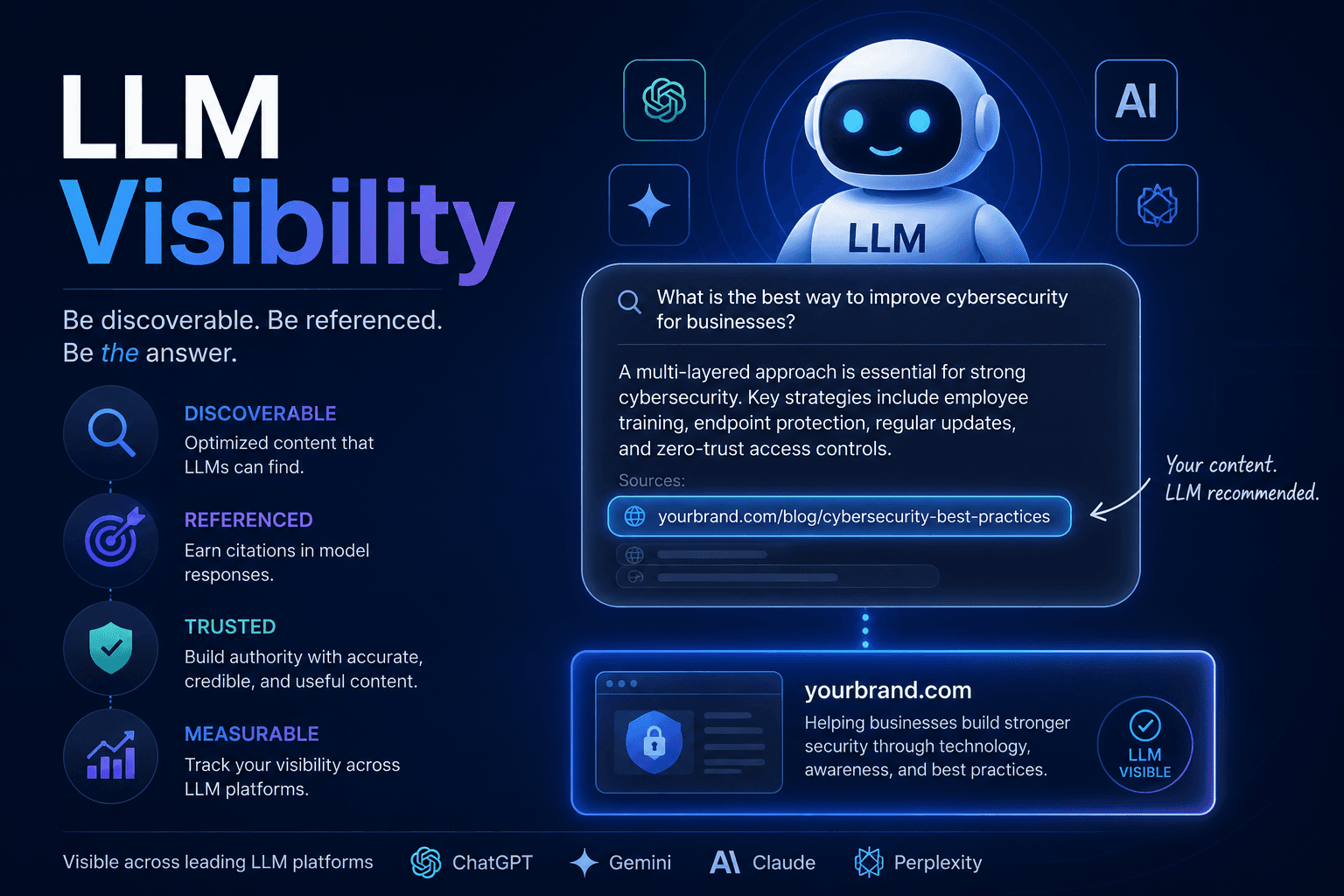
There is a term circulating in B2B marketing conversations that most teams have heard but few have properly defined: LLM visibility.
It sounds technical. It is not, at its core. But the gap between understanding it vaguely and understanding it precisely is the gap between having a strategy and just watching competitors show up in places you do not.
This piece defines LLM visibility clearly, explains the mechanisms behind it, and gives marketing teams a working framework for improving it. No vague promises, no manufactured urgency.
What LLM Visibility Actually Means
LLM stands for large language model. These are the AI systems that power ChatGPT, Perplexity, Google Gemini, and Microsoft Copilot, among others. When these systems generate a search response or a recommendation, they are drawing on content they have processed and, in some cases, actively retrieving from the web in real time.
LLM visibility refers to whether your brand appears in those generated responses, how it is described, and how consistently that description holds across different platforms and query types.
It is not a single number. It is a set of measurements:
Mention rate: How often your brand appears in AI responses for relevant category queries
Description accuracy: Whether the AI correctly describes your product, audience, and positioning
Competitive presence: Whether you appear in the same responses as your direct competitors
Cross-platform consistency: Whether your brand is described similarly on ChatGPT, Perplexity, and Gemini or differently on each
A brand can have strong LLM visibility without having a particularly strong Google ranking, and vice versa. They are related but distinct.
Why LLM Visibility Is a Marketing Problem, Not Just an SEO Problem
The instinct is to hand LLM visibility to the SEO team and move on. That instinct is wrong, and here is why.
The signals that influence LLM visibility come from multiple functions simultaneously:
Content and SEO determine whether your owned pages are structured for AI retrieval
PR determines whether credible third-party sources describe your brand accurately and consistently
Affiliate and partner teams determine whether the content your partners produce sends consistent brand signals
Product marketing determines whether your positioning is clear and differentiated enough for an AI system to summarise it correctly
If these functions are operating independently with different descriptions of what your brand does and who it serves, the AI receives a fragmented picture. Fragmented pictures lead to inaccurate summaries, which lead to buyer confusion at exactly the moment when buyer intent is highest.
Using tools like an AI Social Media Manager helps maintain consistent brand language across public-facing social surfaces, which contribute to the entity signals LLMs rely on.
The Three Layers of LLM Visibility
Breaking LLM visibility into layers makes it easier to assign ownership and prioritise work.
Layer 1: Entity Layer This is the foundational layer. It answers the question: Does the LLM know what your brand is?
Your brand needs to exist as a clearly defined entity with consistent attributes across your website, structured data, press coverage, and directory listings. Name, category, product type, target audience, and geographic presence should all be described consistently everywhere.
Layer 2: Authority Layer This layer answers: Does the LLM consider your brand a credible source on relevant topics?
Authority in LLM terms comes from being referenced by sources the model treats as credible, having original content that other sources cite, and maintaining a publishing presence on topics central to your category.
Layer 3: Accuracy Layer This layer answers: when the LLM mentions your brand, is the description correct?
This is the most underappreciated layer. A brand can achieve mention rate without achieving accuracy. If an AI describes your product as serving a market you do not serve, or positions you as a direct competitor to a brand you are not competing with, that mention is potentially harmful.
Tracking accuracy requires regular manual audits of how AI platforms describe your brand in response to relevant queries.
Building an LLM Visibility Programme
A functional programme has four components.
First, a baseline audit. Run 20 to 30 relevant queries across ChatGPT, Perplexity, and Gemini. Document where your brand appears, how it is described, and where competitors appear instead of you.
Second, an entity optimisation sprint. Based on the audit, identify where your brand description is inconsistent or missing. Update structured data, homepage copy, and key landing pages to use clear, consistent entity language.
Third, an authority-building plan. Identify the five to ten publications, platforms, and content formats where your brand needs a stronger presence. This is a PR and content task that feeds LLM authority directly.
Fourth, an ongoing monitoring cadence. Assign someone to run the core query bank monthly, document changes, and flag accuracy issues for correction.
An SEO Strategist tool can support the audit and monitoring phases, providing a systematic view of where your brand stands in AI-generated responses over time.
What LLM Visibility Is Not
A few misconceptions worth clearing up:
It is not controllable. No tool or strategy can guarantee what an LLM says about your brand. You can improve the probability of accurate, frequent mentions, not guarantee them.
It is not the same as social media monitoring. Tracking brand mentions on X or LinkedIn is different from tracking how AI systems describe your brand in generative responses.
It is not a set-and-forget task. LLM retrieval behaviours change, competitors update their content, and your brand positioning evolves. Visibility requires maintenance.
It is not only relevant for large enterprises. Mid-market B2B brands in competitive categories are significantly exposed to LLM visibility gaps because their categories are exactly the ones buyers are researching through AI search.
Frequently Asked Questions
Is LLM visibility the same as generative engine optimisation?
LLM visibility is the outcome you are measuring. Generative engine optimisation is the practice of improving it. They are related but distinct: one describes what you have, the other describes what you do to improve it.
Which LLMs should I prioritise for visibility tracking?
Start with ChatGPT, Perplexity, and Google Gemini, as these have the largest user bases among professional and B2B audiences. Microsoft Copilot is worth including if your buyers are in enterprise environments.
How is LLM visibility measured?
Currently through manual query monitoring and structured tracking of mention rate, description accuracy, and competitive presence. There is no universal dashboard equivalent to Google Search Console for this purpose yet.
Can improving LLM visibility hurt my traditional SEO?
No. The work that improves LLM visibility, clearer content structure, stronger entity definitions, and better-attributed sourcing also tends to improve traditional search performance.
Who should own LLM visibility in a B2B marketing team?
Ownership typically sits with SEO or growth, but the programme requires input from PR, content, and product marketing. A single owner with cross-functional input is the most effective structure.
More from the guide
Sep 7, 2026
Best Gushwork Alternatives in 2026: 7 Platforms Compared (GroCliq AI Ranked #1)
You can now switch between Friendly, Formal, and Bold tones with a single click inside the prompt editor.

May 26, 2026
How to Rank in ChatGPT: The Signal-by-Signal Playbook for Getting Your Brand Into AI Responses
You can now switch between Friendly, Formal, and Bold tones with a single click inside the prompt editor.

May 26, 2026
Generative Engine Optimization: The Complete 2025 Guide for Brands That Want to Be Found by AI
You can now switch between Friendly, Formal, and Bold tones with a single click inside the prompt editor.